



As data rates rise, optical transceivers become more complex, and new form factors appear to carry the extra speed, lanes and heat. Older packages such as 1×9, SFF, GBIC, X2, XENPAK and XFP are now rarely seen. Today, almost every network uses one of three families: SFP, QSFP and OSFP.
This guide explains how these form factors differ, how to compare 800G OSFP and QSFP-DD modules, and what changes at 1.6T. Every example below is a HydraX™ transceiver available from Hermesys.
Common Form Factors at a Glance
| Form Factor | Data Rate | Lanes × Lane Rate | Typical Use | Size | Hermesys Example | Appearance |
|---|---|---|---|---|---|---|
| SFP | Up to 1.25 Gbps | 1 × 1.25G | Gigabit Ethernet, access networks | Small | 1.25G BiDi SFP Transceiver, 20–80 km |  |
| SFP+ | 10 Gbps | 1 × 10G | 10GbE switching, enterprise | Small | 10GBASE-SR SFP+ Transceiver, 300 m |  |
| SFP28 | 25 Gbps | 1 × 25G | 25GbE server access | Small | 25GBASE-SR SFP28 Transceiver, 100 m |  |
| QSFP28 | 100 Gbps | 4 × 25G | Data centre leaf–spine | Medium | 100G QSFP28 SR4 Transceiver, 100 m | 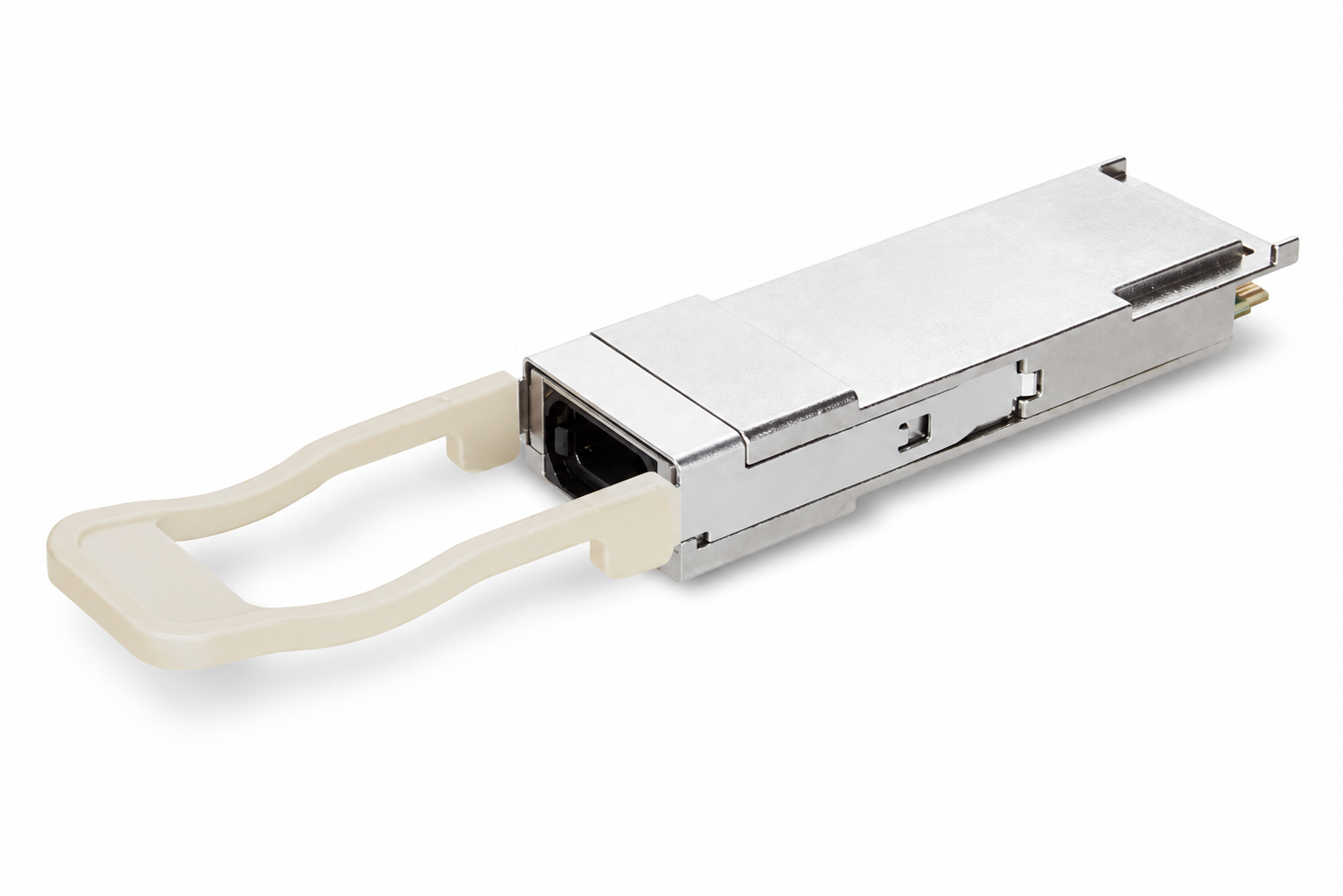 |
| QSFP56 | 200 Gbps | 4 × 50G PAM4 | Data centre, InfiniBand HDR | Medium | 200G QSFP56 SR4 Transceiver, 100 m |  |
| QSFP-DD | 400G / 800 Gbps | 8 × 50G / 8 × 100G | High-density data centre switching | Medium | 400G QSFP-DD DR4, 800G QSFP-DD SR8 | 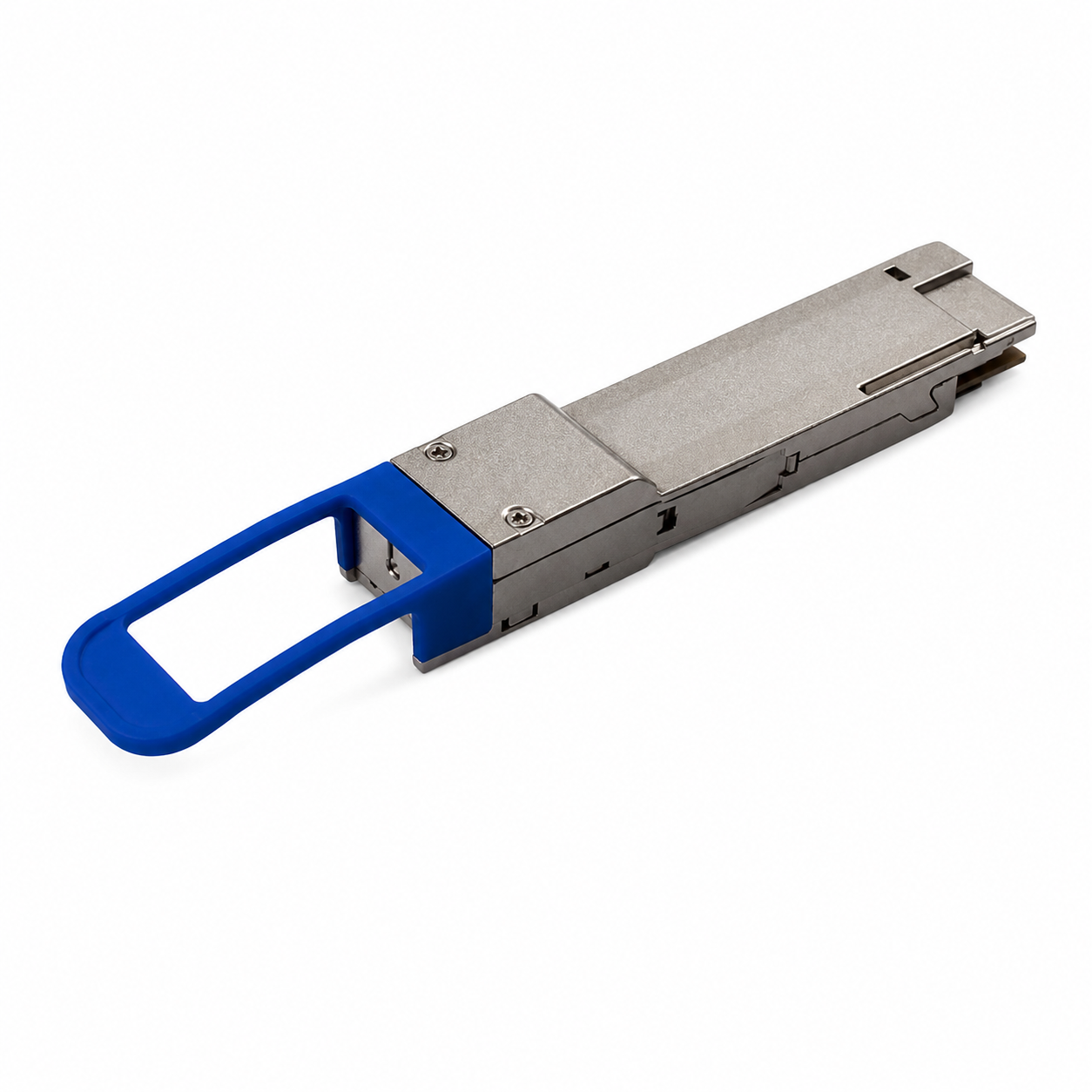 |
| OSFP | 400G / 800G / 1.6 Tbps | Up to 8 × 200G | AI clusters, hyperscale data centres | Large | 400G OSFP DR4, 800G OSFP SR8, 1.6T OSFP 2×DR4 |  |
Three Things to Look At: Size, Speed and Lanes
You do not need to read every MSA specification to understand a form factor. Three factors tell you most of what matters:
- Size. A larger module has more room for components and more surface to release heat. A smaller module fits more ports on a switch faceplate.
- Data rate. The total bandwidth the module carries.
- Lanes. The number of parallel electrical channels. Total speed = number of lanes × speed per lane.
Most speed upgrades come from faster lanes, not more lanes. The lane rate moved from 25G NRZ (QSFP28), to 50G PAM4 (QSFP56, 400G QSFP-DD), to 100G PAM4 (800G), and now to 200G PAM4 (1.6T). This is why an 800G module and a 1.6T module both use eight lanes.
800G: OSFP vs QSFP-DD
800G transceivers carry 800 billion bits per second and are now the workhorse of AI data centres. They come in two main form factors: OSFP and QSFP-DD. Both use eight 100G PAM4 lanes, but they differ in size, cooling and compatibility.
| OSFP | QSFP-DD | |
|---|---|---|
| Appearance | |
 |
| Data rate | 800 Gbps (8 × 100G PAM4) | 800 Gbps (8 × 100G PAM4) |
| Size | 100.4 mm × 22.58 mm × 13.0 mm | 18.35 mm wide × 8.5 mm high, same faceplate size as QSFP28 |
| Cooling | Integrated heat sink (IHS, finned top) or riding heat sink (RHS, flat top) | Supports a riding heat sink design |
| Backward compatibility | OSFP ports only | QSFP-DD800 ports accept QSFP+, QSFP28, QSFP56 and 400G QSFP-DD modules |
| Typical connectors | MPO or LC | MPO or duplex LC |
| Best for | AI/ML training, HPC, hyperscale data centres | Upgrading existing QSFP-based networks with high port density |
| Hermesys example | 800G OSFP SR8, 50 m/100 m | 800G QSFP-DD SR8, 100 m |
Cooling Design: Finned Top vs Flat Top (RHS)
Thermal design is one of the biggest differences between OSFP and QSFP-DD, and it becomes more important as power rises.
- Integrated heat sink (IHS, finned top). Cooling fins are built into the top of the module. Switch airflow passes over the fins and carries the heat away. This suits standard air-cooled switches.
- Riding heat sink (RHS, flat top). The module has a flat top. When it is inserted, a heat sink on the switch or network card presses onto the module and draws the heat away. This suits systems where the host controls cooling, including liquid-cooled platforms.
For example, the HydraX 800G OSFP SR8 is available with a finned top for air-cooled switches, or with a flat (RHS) top for liquid-cooled systems.
The right housing depends on the host equipment, not only the module. In a high-density data centre, cooling, installation space and cable management all shape the choice.
1.6T: OSFP1600 vs QSFP-DD1600
1.6T transceivers entered volume shipment in 2026. According to industry analyst Cignal AI, 1.6TbE module shipments are on track to exceed 10 million units this year.
1.6T modules keep the eight-lane design of 800G but double the lane rate to 200G PAM4. The matching Ethernet standard is IEEE 802.3dj, which covers 200G, 400G, 800G and 1.6T Ethernet and is expected to be formally approved by the end of 2026.
Both form factor families have a 1.6T version. The OSFP MSA defines OSFP1600. The QSFP-DD MSA introduced QSFP-DD1600 in hardware specification Rev 7.0 at ECOC 2023, updated to Rev 7.1 in June 2024.
| OSFP1600 | QSFP-DD1600 | |
|---|---|---|
| Data rate | 1.6 Tbps (8 × 200G PAM4) | 1.6 Tbps (8 × 200G PAM4) |
| Specification | OSFP MSA | QSFP-DD MSA Hardware Rev 7.0 / 7.1 |
| Module width | 22.58 mm | 18.35 mm |
| Cooling | Integrated heat sink or riding heat sink | Riding heat sink |
| Backward compatibility | OSFP ecosystem | Full QSFP and QSFP-DD family of modules and cables |
| Market status | Main form factor for 1.6T deployments today | Specification published, fewer deployments so far |
HydraX™ 1.6T OSFP Portfolio
All Hermesys 1.6T products use the OSFP1600 form factor. The optical transceivers use an OSFP-RHS Type 2 housing per OSFP MSA Rev 5.1, with CMIS 5.3 management and a 0–70 °C operating range.
| Product | Interface | Reach | Connector | Power |
|---|---|---|---|---|
| 1.6T 2×DR4 OSFP-RHS Transceiver | 1.6TBASE-DR8 optical, 1.6TAUI-8 electrical; EML transmitter, PIN receiver | 500 m, single-mode | Dual MPO-12/APC | Up to 30 W (2 W low-power mode) |
| 1.6T 2×FR4 OSFP-RHS Transceiver | 2 × 800GBASE-FR4 optical, 2 × 800GAUI-4 electrical; EML transmitter, PIN receiver | 2 km, single-mode | Dual LC | Up to 30 W (2 W low-power mode) |
| 1.6T OSFP Active Copper Cable (ACC) | 8 × 200G PAM4, 26 AWG | Up to 2.5 m | — | Under 3 W per end |
| 1.6T OSFP Active Electrical Cable (AEC) | 8 × 200G PAM4, 26 AWG | Up to 4 m | — | See product page |
How to Choose
- Upgrading an existing QSFP network? QSFP-DD keeps backward compatibility with QSFP28 and QSFP56, so you can reuse existing modules and move up step by step.
- Building an AI or HPC cluster? OSFP gives more thermal headroom for high-power modules and is today's main form factor for 1.6T.
- Check the host cooling first. For OSFP, match the module housing (finned top or flat top RHS) to the switch or network card.
- Short links inside the rack? 1.6T ACC and AEC cables can replace optics for very short connections at lower power.
What Comes Next
The industry is already preparing for 3.2T, based on 400G-per-lane technology. 3.2T is still in development and sampling, and volume deployment is widely expected around 2028. The OSFP MSA has also published the OSFP-XD specification for higher-density modules, and co-packaged optics (CPO) is expected to play a growing role at 3.2T and beyond.
Find the Right Transceiver
Hermesys HydraX™ optical transceivers cover data rates from 100 Mbps to 1.6 Tbps, in SFP, SFP+, SFP28, QSFP28, QSFP56, QSFP-DD and OSFP form factors. Browse the full range or contact our team for help selecting modules for your network.