


An RS-485 armored cable is a 120 Ω shielded twisted-pair data cable with a metal armor layer and a protective outer jacket. The twisted pair carries the differential RS-485 signal, the shield blocks electrical noise, and the armor protects the cable from crushing, impact and rodents where it runs buried, exposed or through heavy plant.
In chemical plants, water treatment works and food factories, a standard RS-485 cable fails long before its electrical life is over. Oil, chemical vapor, moisture and mechanical damage attack the jacket first, then the signal. This guide explains when armor is worth it, how the main armor types and jacket materials compare, and what to check when installing the cable.
Key takeaways
- Steel wire armor (SWA) is the standard choice for direct burial and heavy-duty routes.
- A PA12 (nylon 12) outer sheath resists oils, fuels and most solvents, but not strong mineral acids.
- Keep the whole RS-485 trunk on 120 Ω cable and terminate it with 120 Ω at both ends.
- Bond the signal shield at one end; earth the armor at both ends through the glands.
When Do You Need an Armored RS-485 Cable?
Choose an armored cable when the route exposes the cable to mechanical damage that conduit or tray cannot fully prevent. Typical cases:
- Direct burial between buildings, tanks or pump stations, where soil pressure, stones and digging can damage the cable
- Rodent and termite risk in cable trenches, outdoor ducts and tropical sites
- Heavy plant areas where forklifts, falling tools or maintenance work can crush an exposed run
- Long outdoor runs on racks or walls without full conduit protection
- Chemical or oily environments, where the armor is paired with a resistant outer jacket
In a clean control room or a fully enclosed cable tray, a standard shielded RS-485 cable is usually enough and is easier to install.
Armor Types Compared: SWA vs Interlock vs Steel Tape vs Braid
For direct burial and heavy-duty industrial routes, steel wire armor (SWA) is the most common choice because it combines crush resistance with high pulling strength.
| Armor type | Construction | Strengths | Limitations | Typical use |
|---|---|---|---|---|
| SWAHERMESYS | Galvanized round steel wires laid helically | High crush and tensile strength; suits direct burial and vertical runs | Heavier and stiffer than other types | Buried runs, outdoor plant, IEC/BS markets |
| Interlock (SIA / AIA) | Steel or aluminum strip formed into a locking spiral | Flexible, good crush protection | Lower tensile strength; often still installed in tray | North American industrial wiring |
| Steel tape (STA) | Two overlapping steel tapes | Good crush and rodent protection at low cost | Poor tensile strength; not for pulling or vertical drops | Ducts and trenches with short pulls |
| Wire braid (GSWB) | Woven galvanized steel wires | Flexible, light | Lighter mechanical protection | Ships, machines, moving installations |
All four protect the signal pairs mechanically. Electrical noise is handled by the cable's foil and copper braid shield, not by the armor.
Choosing the Right Jacket: PVC, PE, PA12 or LSZH
The outer jacket decides how long the cable survives its environment. For sites with oil, fuel and solvent exposure, a PA12 (nylon 12) outer layer outperforms PVC and PE.
| Jacket | Oil & hydrocarbons | Moisture | UV (black) | Fire behavior | Best for |
|---|---|---|---|---|---|
| PVC | Fair; can swell or harden with long exposure | Good | Fair | Self-extinguishing; emits halogen smoke | General indoor and dry industrial runs |
| PE | Fair | Excellent | Excellent | Burns; not flame retardant | Direct burial and wet outdoor routes |
| PA12HERMESYS | Excellent against oils, fuels and most solvents | Excellent | Good | Varies by compound | Petrochemical, oily and termite-prone sites |
| LSZH | Fair to good, depends on compound | Fair | Varies | Low smoke, no halogen | Enclosed public spaces, tunnels, data centers |
PA12 resists oils, fuels, greases and many solvents, but strong mineral acids such as concentrated sulfuric or nitric acid will attack it. For acid-heavy areas, check chemical compatibility with us before ordering.
PA12 also forms a hard, smooth skin. That makes it a common outer layer for termite- and rodent-resistant cable designs.
Inside the Hermesys SWA + PA12 RS-485 Cable
The Hermesys armored RS-485 cable combines dual shielding, steel wire armor and a three-layer PE + PE + PA12 sheath system.
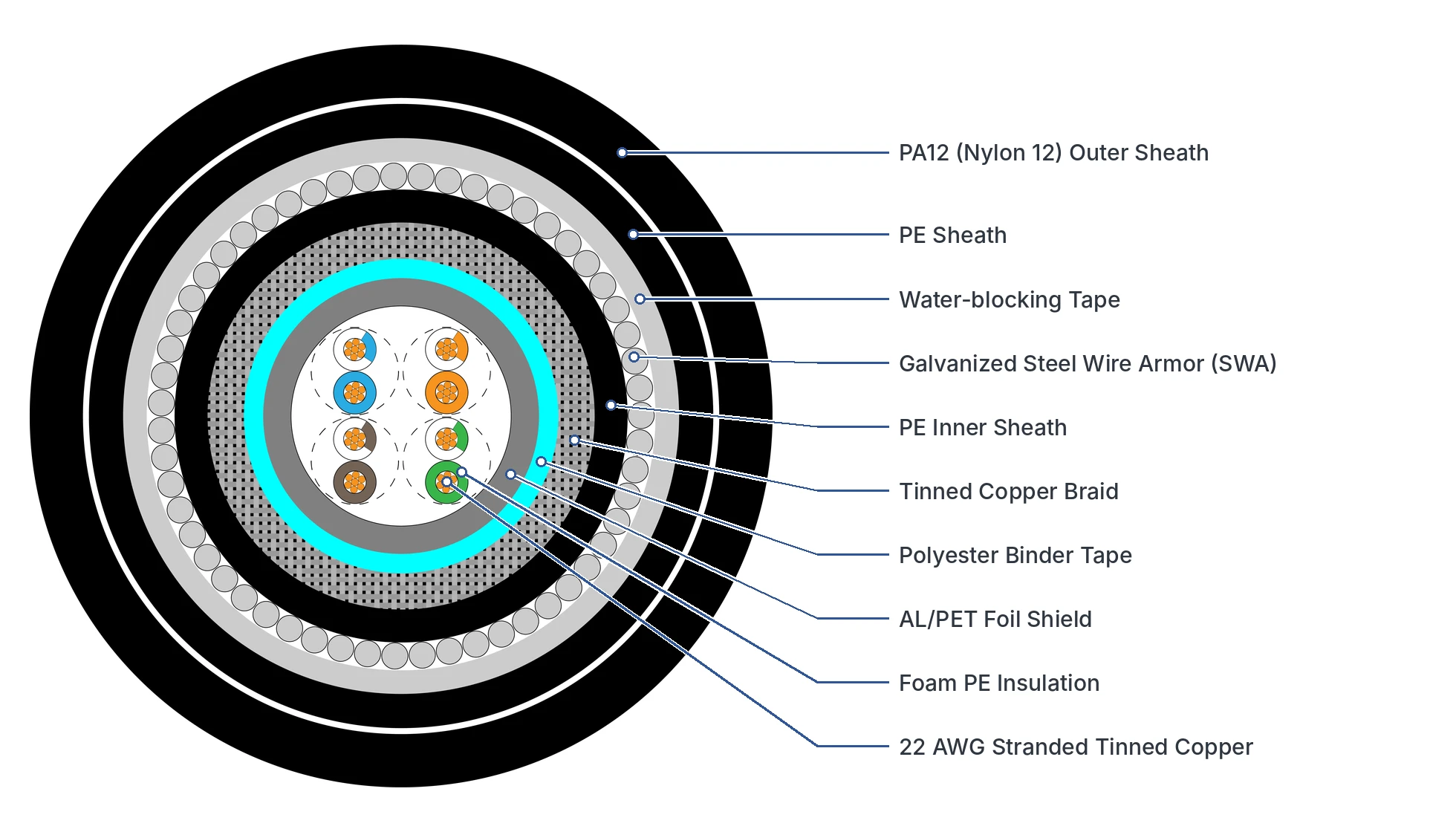
From the center out:
- Conductors: 22 AWG stranded tinned copper. Tinning resists oxidation in humid and corrosive air.
- Insulation: foamed polyethylene, keeping capacitance and signal loss low over long runs.
- Twisted pairs: 2P or 4P, twisted to reject common-mode noise.
- Foil shield: AL/PET foil around the pair bundle for full coverage against high-frequency noise.
- Binder tape: polyester tape holding the shielded core together.
- Overall braid: tinned copper, at least 60% coverage, for low-frequency noise from motors and drives.
- Inner sheath: black PE, bedding the shielded core under the armor.
- Armor: 0.9 mm galvanized steel wires, helically laid, at least 90% coverage.
- Water-blocking tape: stops water traveling along the cable if the outer layers are damaged.
- PE sheath: black PE for moisture protection and structure.
- Outer sheath: PA12 (nylon 12), resisting oils, fuels, solvents and abrasion.
The result is a cable that can be buried directly, pulled through rough ducts or run along process equipment without a separate protective conduit.
Electrical Performance
The cable is built to the 120 Ω impedance that TIA-485-A transceivers expect, and works with Modbus RTU, PROFIBUS DP and BACnet MS/TP networks.
| Parameter | Test condition | Value |
|---|---|---|
| Characteristic impedance | 1 MHz | 120 ± 15 Ω |
| Mutual capacitance | 800 Hz | Approx. 42 pF/m |
| Attenuation | 1 MHz | ≤ 20 dB/km |
| Conductor DC resistance | 20 °C | ≤ 55 Ω/km |
| Dielectric strength | DC 2 kV, 1 min | No breakdown |
An RS-485 bus is terminated with 120 Ω resistors that match the cable. If part of the run uses a 100 Ω cable (common for Ethernet-style twisted pair), the impedance step reflects part of the signal. At low baud rates this is often tolerated; at higher rates and longer runs it causes bit errors. Keep the whole trunk on 120 Ω cable, including any armored outdoor section.
Installation Tips: Distance, Grounding, Termination and Burial
Plan length against baud rate
RS-485 reaches about 1,200 m at low data rates, and the usable length falls as speed rises. A common rule of thumb is length (m) × data rate (bit/s) ≤ 108.
| Data rate | Typical maximum length |
|---|---|
| Up to 100 kbit/s (incl. 9.6 kbit/s Modbus) | ~1,200 m |
| 500 kbit/s | ~200 m |
| 1 Mbit/s | ~100 m |
| 10 Mbit/s | ~10 m |
Actual reach also depends on transceivers, node count and cable resistance, so test long or fast links on site.
Ground the shield and the armor separately
- Bond the signal shield at one end only, usually at the control panel, to avoid ground loops through the shield.
- Earth the steel armor at both ends through the cable glands, as local electrical codes require for safety.
- Do not use the armor as the shield or as the RS-485 signal reference. Run a separate common/reference conductor where the devices need one.
Terminate and bias correctly
Fit a 120 Ω resistor across the pair at each end of the trunk, not at every node. Apply fail-safe bias at one point only, usually at the master.
Burial and gland practice
- Use armored cable glands that clamp and earth the armor at every enclosure entry.
- Respect the minimum bending radius during pulling; kinked armor cannot be straightened.
- Seal cut ends before burial so water does not enter while the cable waits to be terminated.
- Mark the route and lay warning tape above directly buried cable.
Where It Is Used
Chemical & petrochemical plants
Links between PLCs, DCS cabinets, sensors and valve positioners around tank farms, process units and pipe racks, where oil, fuel and solvent vapor are present. For classified hazardous areas, confirm the cable and gland certification required by the site.
Water & wastewater treatment
Buried and duct runs between pump stations, clarifiers and control buildings, where moisture, hydrogen sulfide and ground movement are constant.
Pharmaceutical & food processing
Process lines exposed to oils, fats and alcohol-based cleaning agents during washdown. Check compatibility if acid-based CIP chemicals are used.
For indoor RS-485 runs without armor, see the ChimeraX™ RS-485 Modbus communication cable. For armored control wiring alongside the data link, see the ChimeraX™ SWA armoured control cable.
Frequently Asked Questions
Can RS-485 armored cable be buried directly?
Yes, if it has steel wire armor, a moisture barrier and a PE or similar outer sheath. The Hermesys cable uses SWA, water-blocking tape and a PE + PA12 sheath for direct burial. Follow local codes for burial depth and warning tape.
What is the maximum length of an RS-485 cable?
About 1,200 m at data rates up to roughly 100 kbit/s. At 1 Mbit/s the practical limit is around 100 m. Transceivers, node count and cable quality all affect the result.
Can I mix 100 Ω and 120 Ω cable on one RS-485 bus?
It is not recommended. The impedance step reflects part of the signal and can cause errors at higher speeds or longer distances. Use 120 Ω cable for the whole trunk.
Should the armor be grounded at one end or both ends?
The armor is normally earthed at both ends through the cable glands for electrical safety. The signal shield is a separate layer and is usually bonded at one end only.
What is the difference between SWA and steel tape armor?
SWA uses round steel wires and handles both crushing and pulling loads, so it suits burial and vertical runs. Steel tape armor protects well against crushing but has little tensile strength, so it suits short pulls in ducts.
Is a PA12 jacket resistant to acids?
PA12 resists oils, fuels, greases and many solvents, and handles dilute alkalis well. Strong mineral acids will attack it, so check compatibility for acid-heavy areas.
Get the Right Cable for Your Site
Every Hermesys armored RS-485 cable is produced under ISO 9001 processes, with impedance monitored during extrusion and mechanical checks before dispatch. Tell us your route length, baud rate and the chemicals on site, and our engineering team will confirm the right construction.